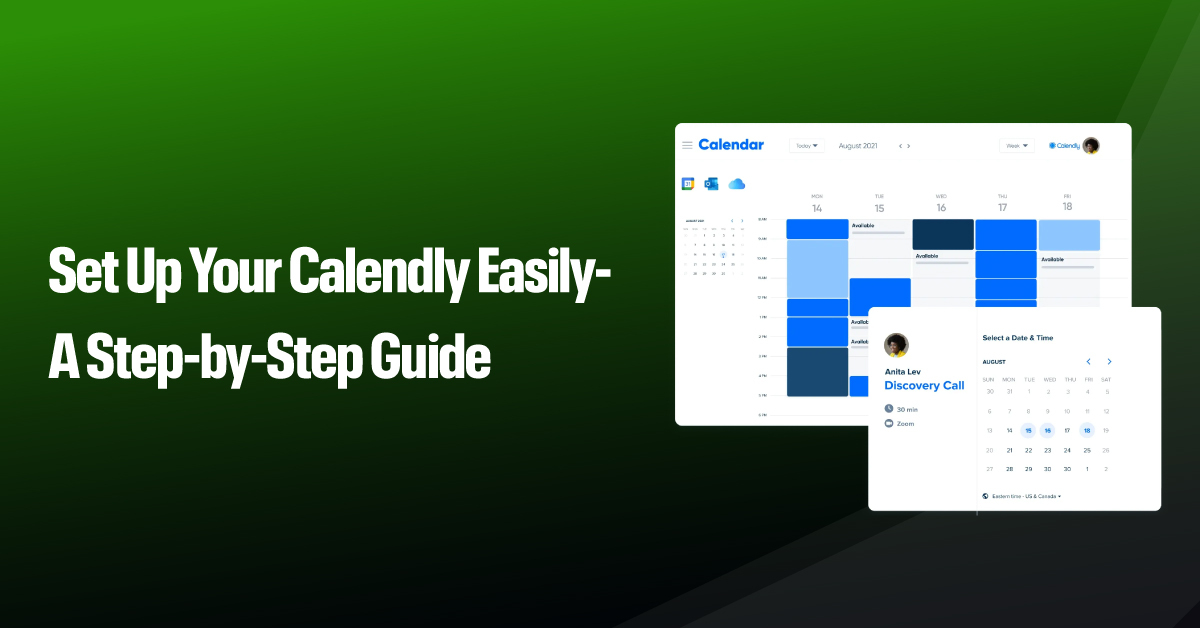
Calendly removes the back-and-forth from scheduling. You define your available hours, create meeting types, and share a link. The other person picks a time that works. No email chains, no double bookings, no follow-up reminders to confirm.
But the default Calendly setup is bare-bones. To get the real value, automated video links, CRM sync, lead routing, team scheduling that you need to configure it correctly from the start.
This guide walks you through every step: account creation, calendar connection, event type setup, integrations, embedding, and testing. By the end, you will have a scheduling system that works while you focus on everything else.
Step 1: Create Your Calendly Account
Go to calendly.com and sign up using your email, Google account, or Microsoft account. The process takes under two minutes.

Once you are inside, Calendly will ask two questions:
Who are you scheduling for?
- Choose “on my own” if you are the only person who needs a booking page.
- Choose “with my team” if you need shared scheduling, round robin distribution, or collective events across multiple people.
What is your role? Answer honestly. Calendly uses this to surface relevant features and templates. You can skip it if you prefer.
After signup, you land in the Calendly dashboard. Do not start sharing your link yet. Complete the setup steps below first, or your booking page will be incomplete and unprofessional.
Step 2: Connect Your Calendar and Set Availability
Connect Your Calendar
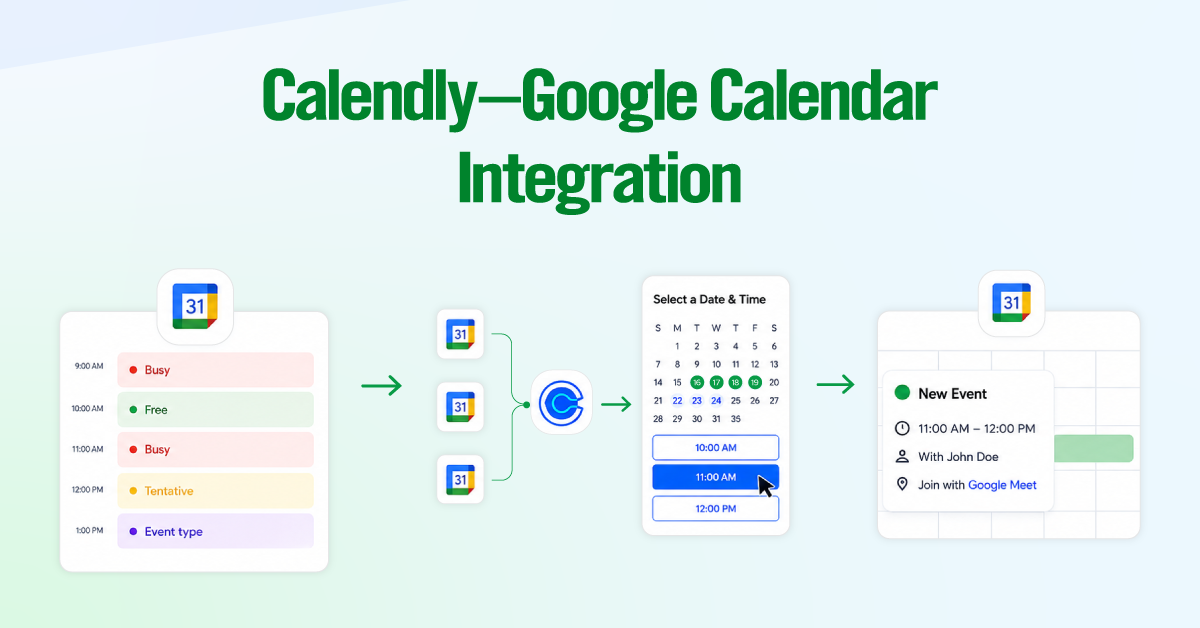
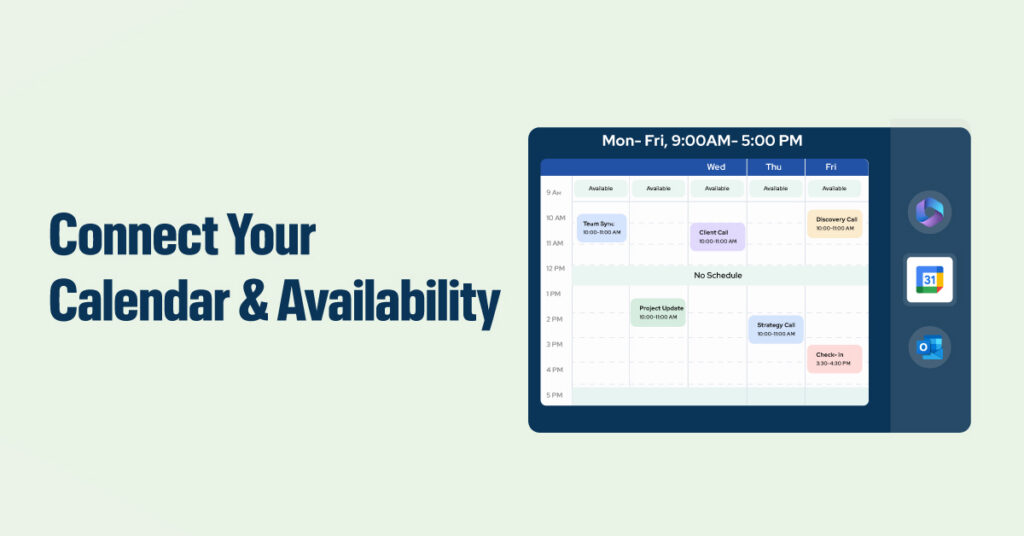
Your calendar is the foundation of your Calendly setup. Without it, Calendly cannot check your real availability and double bookings become inevitable.
Go to Calendar Connection in your account settings and link:
- Google Calendar (recommended for Google Workspace users)
- Outlook Calendar or Microsoft 365 (recommended for Microsoft environments)
- iCloud Calendar (for Apple-native setups)
You can connect multiple calendars for conflict checking. For example, link both your work and personal Google calendars so Calendly blocks time when either has an existing event.
Choose one calendar as the destination where new bookings will be created. This is usually your primary work calendar.
Set Your Availability Rules
Availability rules define when people can book with you. Go to Availability in your dashboard and configure:
- Working days and hours. for example, Monday through Friday, 9:00 AM to 5:00 PM
- Time zone: set this correctly. Calendly handles time zone conversion for invitees automatically, but only if your own setting is accurate
- Buffer time: add time before and after meetings so you are not scheduling back-to-back. A 10-minute buffer before calls and 15 minutes after is a common starting point
- Minimum scheduling notice: the minimum lead time someone needs to book with you. Setting this to 4–24 hours prevents last-minute bookings when you are not prepared
- Maximum days in advance: limits how far out someone can book. Setting a 30–60 day window keeps your schedule manageable
Complete your profile before moving forward: add your name, profile photo, and confirm your time zone. These fields appear on your public booking page and directly affect whether prospects trust the scheduling experience enough to complete a booking.
Step 3: Create Your Event Types

What Are Event Types?
Event types are reusable meeting templates. Each one defines the meeting name, duration, location, availability window, questions asked of the invitee, and any limits on bookings. You create them once and reuse them indefinitely.
Think of event types as pre-built configurations for different kinds of meetings you hold regularly.
Examples:
- 15-minute introductory call
- 30-minute sales discovery call
- 60-minute strategy session
- 20-minute product demo
- Recurring weekly client check-in
Create a One-on-One Event Type
Click + Create and select One-on-One. Configure:
- Meeting name: use a name your invitee will recognize, not internal jargon. “Discovery Call” works better than “Intro Sync.”
- Duration: set a realistic length. Shorter is usually better for initial meetings.
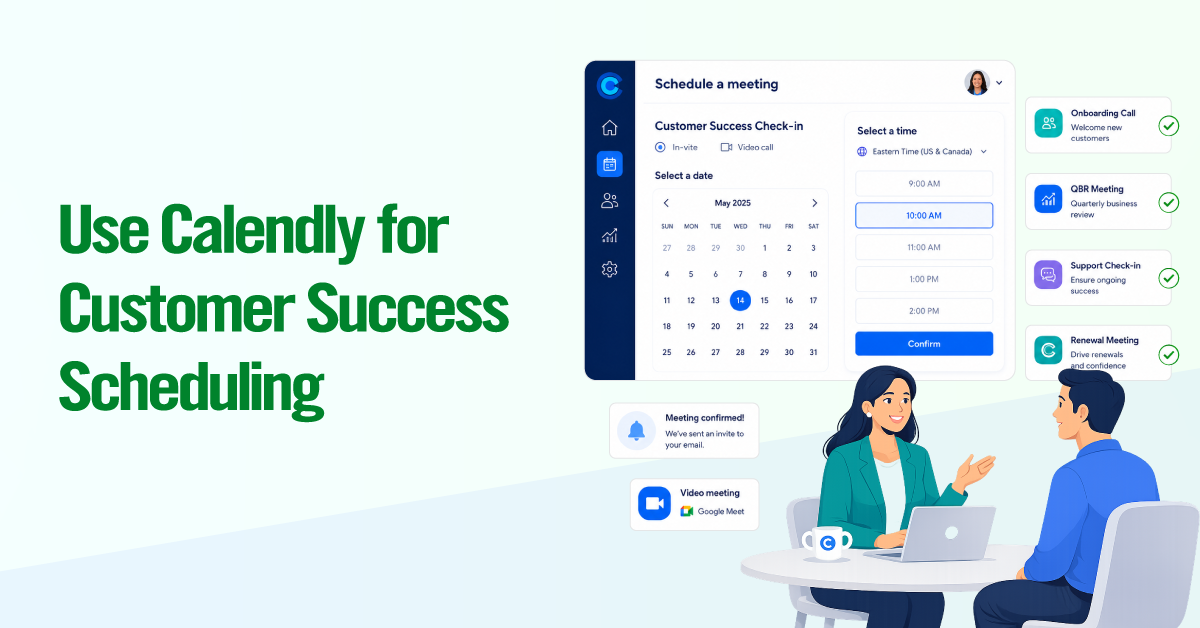
- Location: choose Zoom, Google Meet, Microsoft Teams, a phone call, or an in-person address. If you connect a video conferencing tool (covered in Step 4), the meeting link generates automatically.
- Description: a one or two sentence description of what the meeting covers appears on the booking page. Use it to set expectations and reduce no-shows.
Click More Options to access advanced configuration:
- Invitee questions: ask for information you need before the call. Common fields: company name, website, the specific challenge they want to discuss. Keep this to two or three fields. Every additional required field reduces booking completion rates.
- Booking confirmation page: customize the message or redirect invitees to a specific URL after booking.
- Cancellation and rescheduling settings: decide whether invitees can cancel or reschedule, and set a cutoff window.
Create Group Events
A group event lets multiple invitees book the same time slot. Useful for:
- Webinars
- Training sessions
- Product onboarding sessions
- Office hours
- Group coaching calls
Click + Create and select Group. Under Event Details, look for Invite Limit — this controls how many people can book the same time slot. Once the limit is reached, that slot disappears from your booking page.
Set Up Round Robin Scheduling for Teams
Round robin scheduling distributes new bookings across available team members automatically. Useful for:
- Sales team lead distribution
- Customer support queues
- Demo request routing
- Recruiting interview scheduling
Click + Create and select Round Robin. Configure:
- Team members: add the team members who will receive bookings
- Routing rules: distribute based on equal share, priority weighting, or availability
- Pooled availability: Calendly shows the combined availability of all team members, so invitees always find a slot even when individual team members are fully booked
Use More Options to add intake questions and collect context before the booking reaches your team.
Best practice: Keep intake forms short. Every required field is a drop-off point. Collect only what your team genuinely needs to prepare for the call.
Final Event Type Configuration Checklist
Before publishing any event type, verify:
- Meeting duration is accurate
- Buffer time is set before and after
- Daily booking limits are configured if you need them
- Scheduling notice minimum is set
- Date range is appropriate (rolling 30 or 60 days is standard)
- Weekend availability is intentionally on or off
Step 4: Connect Your Integrations
Integrations are where Calendly moves from a scheduling link to an operational system.
Video Conferencing
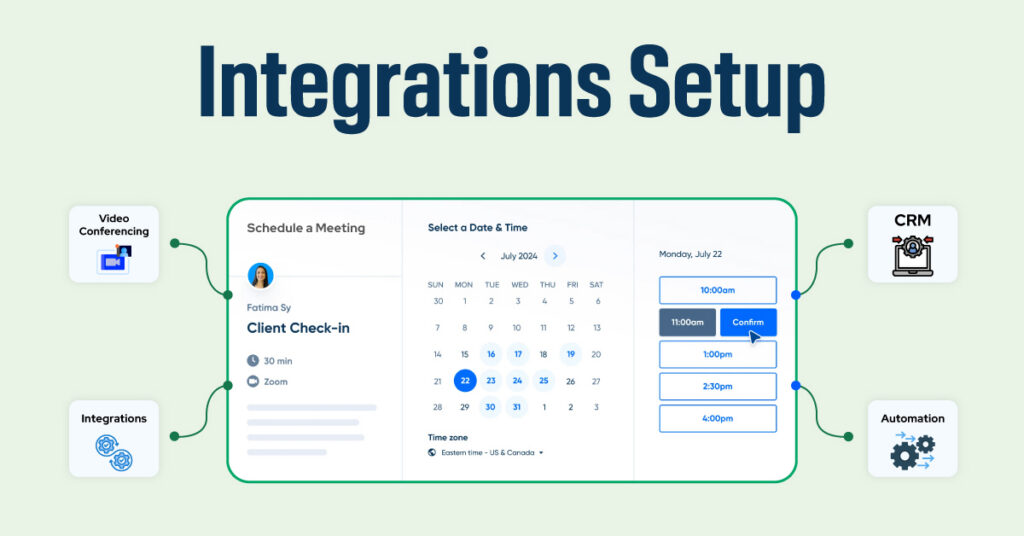
Connect Zoom, Google Meet, or Microsoft Teams so meeting links are generated and included in calendar invites automatically when someone books.
Go to Integrations in the left navigation, find your video platform, and click to connect. Once connected, set it as the default location on any event type that uses video.
Without this integration, you either need to add meeting links manually or risk sending invites with no way to join the call.
CRM Integration
CRM integration captures lead data from every booking and keeps your pipeline current without manual entry.
Supported CRMs include HubSpot, Salesforce, and Pipedrive. When connected:
- New contacts are created or matched automatically in your CRM when someone books
- Meeting activity is logged against the contact record
- Deal stages can be updated based on booking events
Go to Integrations, select your CRM, and follow the authentication steps. After connecting, map the fields in Calendly to the fields in your CRM so data flows into the right places.
This is the highest-leverage integration in most business setups. If your team uses a CRM, connect it before you start taking bookings.
Zapier and Workflow Automation
For tools Calendly does not natively integrate with, use Zapier or Make to build custom workflows. Common automations:
- Create an Asana task when a discovery call is booked
- Send a Slack notification to a sales channel when a demo is scheduled
- Add a new invitee to an email sequence in Active Campaign or Mailchimp
- Update a deal in Pipedrive when a proposal review call is booked
Notification Settings
Before moving on, configure email notifications for both you and your invitees:
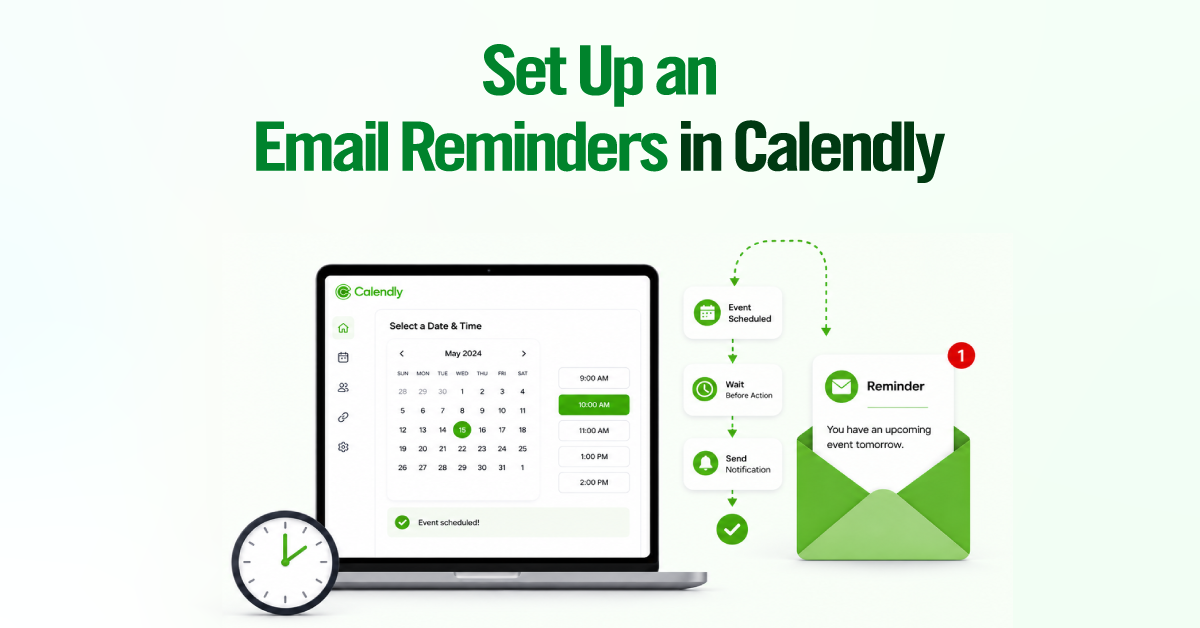
- Confirmation emails: sent immediately when a booking is made. Always enable these.
- Reminder emails: sent 24 hours and 1 hour before the meeting. Enabling reminders measurably reduces no-shows.
- Follow-up emails: sent after the meeting. Useful for next steps, feedback requests, or link sharing.
- Cancellation and reschedule notifications: keeps both parties informed if plans change.
Step 5: Share and Embed Your Booking Link
Share Your Scheduling Link
After your event types are configured, copy your booking link from the dashboard and share it:
- Add it to your email signature
- Include it in proposals and follow-up emails
- Post it in your LinkedIn profile
- Add it to your Slack or Teams status
You can share a link to your full booking page (which shows all your event types) or a direct link to a specific event type. For most outbound outreach, link directly to the most relevant event type rather than your general page.
Embed Calendly on Your Website
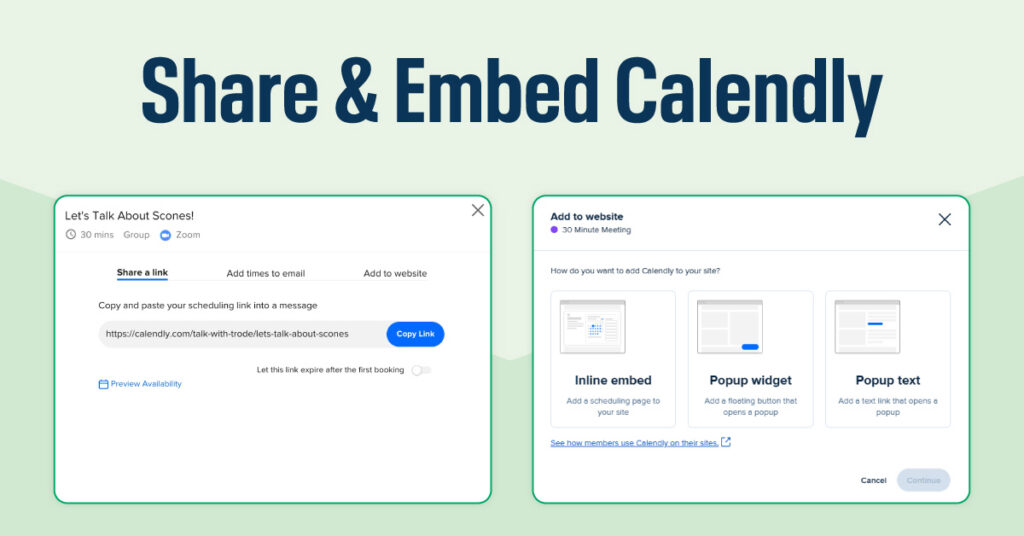
Embedding puts your booking page directly on your website without requiring visitors to navigate to a separate URL. Calendly offers three embed options:
- Inline embed: The full scheduling interface appears as a section within your page. Best for: dedicated booking pages, contact pages, and service pages where scheduling is the primary call to action.
- Popup widget: A floating button sits on the edge of your screen. When clicked, the booking interface opens as a popup overlay. Best for: pages where scheduling is an option but not the primary focus.
- Popup text: A standard text link or button triggers the scheduling popup. Best for: embedding a booking option inline within a paragraph or navigation element.
- To embed, click the three dots on any event type, select Add to Website, and copy the code for your preferred option. Paste it into your website’s page editor or HTML.
- On landing pages: Place the embed after your value proposition, pricing, or testimonials — not at the top of the page. Visitors need context before they commit to a booking.
Test the embed on both desktop and mobile before publishing.
Step 6: Test Your Setup Before Going Live
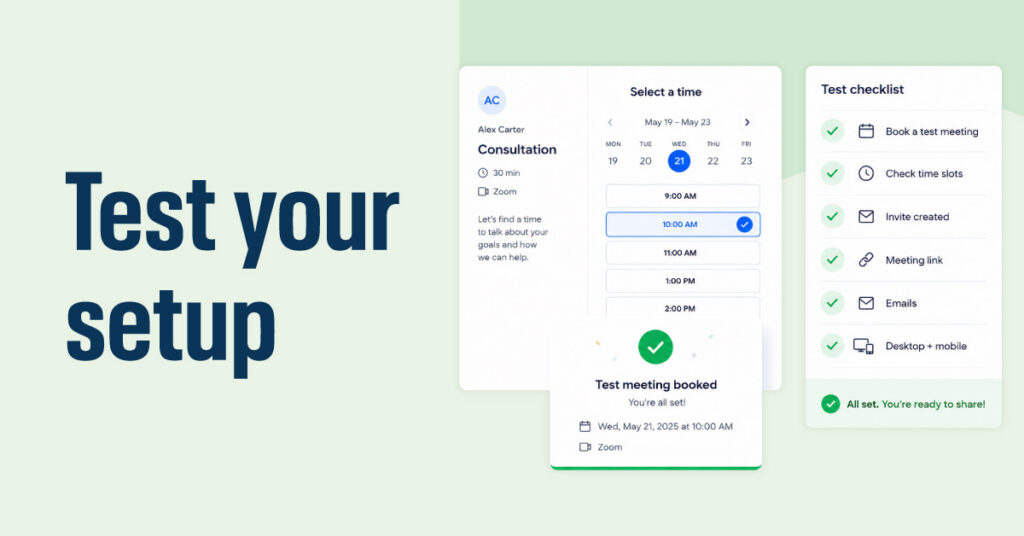
Do not send your Calendly link to prospects or clients before completing a full test. One small configuration error can create a poor first impression that is hard to recover from.
Testing checklist:
- Book a test meeting using your own link, as if you were a real invitee
- Confirm the correct time slots appear based on your availability settings
- Verify the calendar invite is created on both sides with accurate details
- Confirm the video meeting link is generated correctly and included in the invite
- Check that the confirmation email arrived and contains the right information
- Test the reminder email by advancing your test booking time (or check your email automation settings)
- Verify the cancellation and reschedule links in the confirmation email work
- If you embedded Calendly on your website, test the booking flow from the embedded version
- Test the full flow on a mobile device
Fix anything that does not match expected behavior before sharing your link publicly.
Common Calendly Setup Mistakes and How to Avoid Them
Even a basic Calendly setup can break down in predictable ways. Check for these before you go live:
- Wrong time zone: your booking page shows incorrect hours to invitees in other regions. Always set your time zone explicitly in account settings.
- No calendar connected: Calendly cannot check your real availability, which means it may show times when you already have meetings scheduled.
- Video conferencing not connected: meeting links are missing from invites, which forces you to add them manually or send a separate message.
- No buffer time: back-to-back bookings with no transition time between them. Set at least a 10-minute buffer after each meeting.
- Intake form too long: required questions that don’t directly help you prepare for the call reduce booking completion rates. Cut any question you won’t actually act on.
- Reminder emails not enabled: your no-show rate will be higher than it needs to be. Turn on at least a 24-hour reminder.
- Sharing the wrong link: sending your general booking page when you intended to share a specific event type, or sharing a deactivated event link.
- CRM not connected: meeting bookings don’t appear in your CRM, so lead and pipeline data falls out of sync.
- Not tested on mobile: a significant portion of invitees will view your booking page on a phone. A layout that breaks on mobile creates friction and lost bookings.
Conclusion
Calendly is simple when you set it up in the right order. Start with your account. Then connect your calendar. Next, set your availability. After that, create event types, add video conferencing tools, connect your CRM, and share your booking link.
Before you go live, test the full booking flow.
A good Calendly setup helps you save time, avoid double booking, reduce no-shows, and make it easy for people to meet with you.