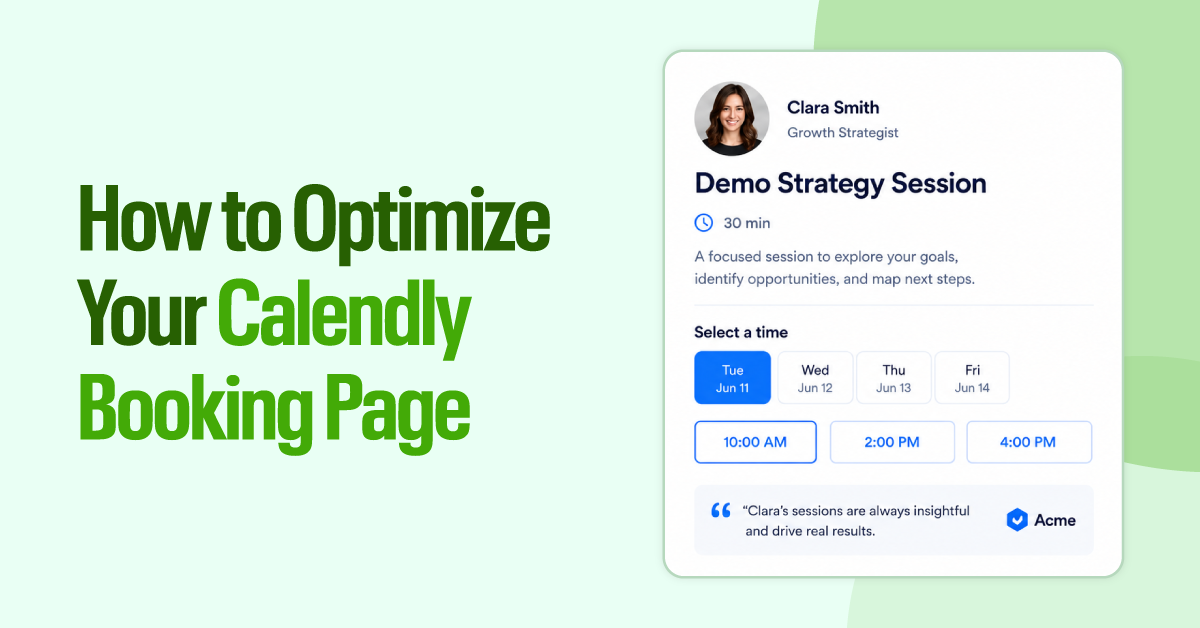
Most people set up Calendly once, paste the link into an email signature, and never touch it again. That single decision quietly costs them meetings. The booking page is the last step between an interested prospect and a confirmed call.
If it loads slowly, reads generically, or asks for the wrong things, people leave at the finish line, and you never find out, because a meeting that never gets booked leaves no trace in your calendar.
We have optimized hundreds of Calendly booking pages, and the pattern is consistent: a properly set-up page does not just schedule meetings; it reassures the visitor, filters out poor fits, and removes the small frictions that cause people to abandon the booking process.
This guide covers the settings inside Calendly that move the needle, the branding choices that build trust, and the technical factors most people skip: speed, mobile, and tracking. Work through it in order, and you will end up with a page that books more of the right meetings and produces fewer no-shows.

TL;DR
- Name events by outcome, not duration, and write descriptions that pre-qualify bookers and set expectations.
- Limit your availability to intentional blocks with buffers and a daily cap, rather than showing every open hour.
- Add a real photo, your logo, and a clean URL slug so the page looks legitimate and earns trust in the first second.
- Embed the page on a dedicated landing page with a clear value proposition and social proof next to the widget.
- Fix page speed and mobile experience, then track the funnel with Google Analytics events and UTM parameters to find where bookings drop off.
Why Your Calendly Page Is a Conversion Point, Not Just a Scheduling Tool?
A scheduling tool answers one question: when are you free? A booking page that converts answers three more before the visitor commits. Is this the right person for me? Can I trust them? Is this worth my time?
Every visitor runs that evaluation whether you design for it or not. A vague event title, a wall of open slots, a missing photo, or a slow load each subtracts a little confidence. Enough small doubts, and the person closes the tab. You will not see it happen, which is exactly why so many people assume their page is fine when it is leaking bookings.
Once you treat the page as a conversion point, your setup changes. You stop displaying everything and start guiding the visitor toward one clear action.
1. Start with the Account settings overview
3 account settings options control how the page looks and behaves.
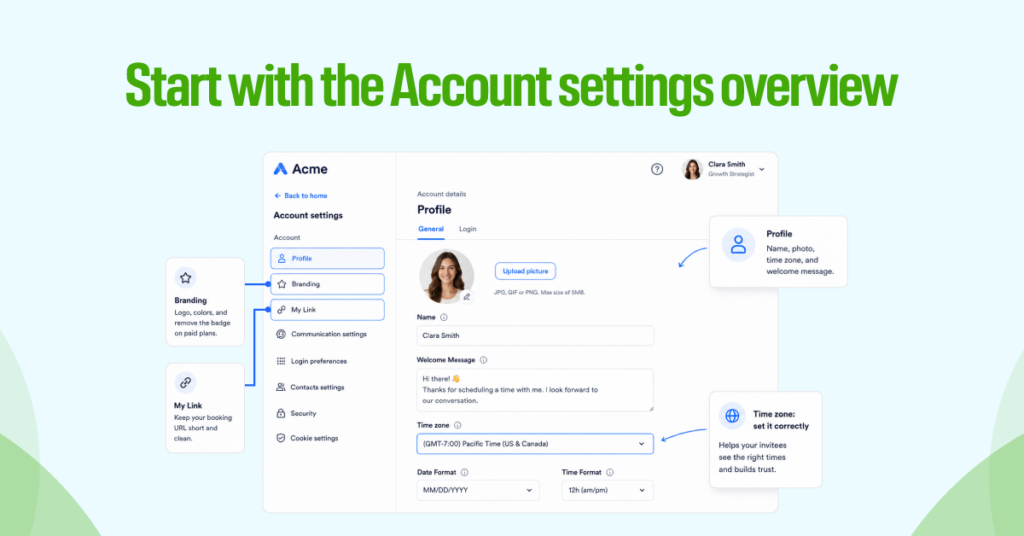
Profile settings hold your name, photo, time zone, and welcome message. These appear on the page and in confirmation emails. Set the time zone correctly here. A wrong time zone is the most common reason bookers complain that a meeting landed at the wrong hour, and it erodes trust instantly.
Branding is where you upload a logo, set colors, and, on paid plans, remove the “Powered by Calendly” badge. This area controls how legitimate the page looks, which matters more than most people assume.
My Link is your default booking URL. You can edit the slug here. Treat it like a domain name and keep it short and clean.
Five minutes here makes every step below faster, because you will know where each control lives.
2. Customize Your Event Name, Description, and Confirmation Text
The highest leverage change available to you is customizing your event or meeting name and description, which costs nothing. Name the outcome, not the time block.
“30-Minute Call” describes duration. “30-Minute Strategy Session” describes what the person walks away with.
The reason this works is simple: people decide whether to give up their time based on expected value, and a name that states the value raises that expectation. It also pre-qualifies. Someone unwilling to book a “Strategy Session” is unlikely to be a serious lead anyway.
| Weak event name | Stronger event name |
| 30-Minute Call | 30-Min Growth Strategy Session |
| Intro Meeting | Discovery Call: Is This a Fit? |
| Consultation | 45-Min Website Audit and Action Plan |
Use the description to set expectations. State who the meeting is for, what happens on the call, and what to prepare. It filters out poor-fit bookers before they take a slot and primes good-fit ones to arrive ready, which raises the quality of every meeting that lands. Keep it to two or three short lines so it gets read.
Rewrite the confirmation and reminder text in your own voice. The defaults are functional and forgettable. A confirmation that sounds like you, tells the person exactly what happens next, and reflects honest scarcity if it applies (“I hold a limited number of slots each week”) keeps the booker engaged between booking and showing up, which is where no-shows are won or lost.
4 things to cut:
- Event names that describe duration instead of value
- Empty descriptions that leave bookers guessing
- Default confirmation and reminder text
- Intake questions you do not actually need, since every extra field lowers completion
3. Show the Right Slots, Not All of Them: Availability Settings
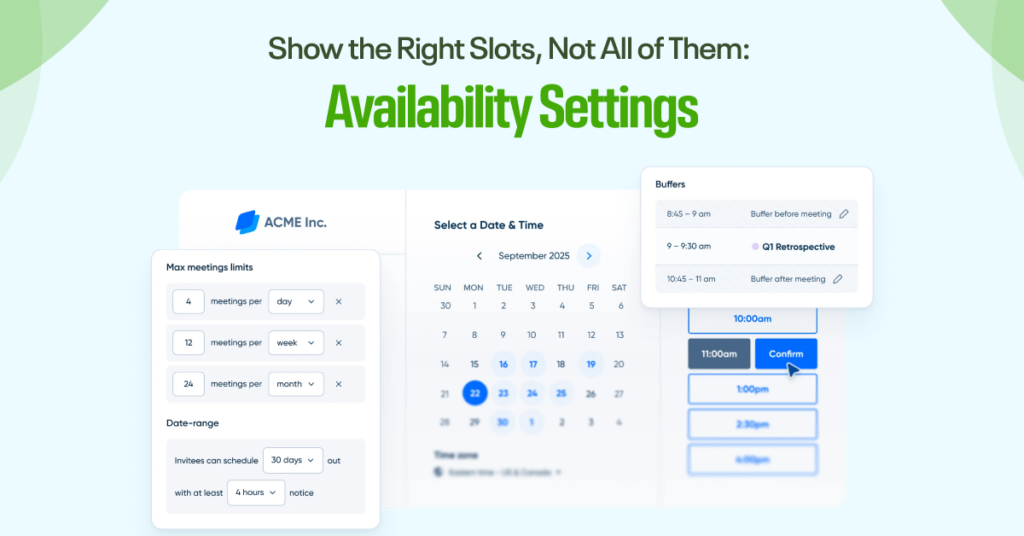
Showing every open hour makes your time look unclaimed. Limiting availability does the opposite. It makes booking feel like grabbing a spot rather than filling an empty calendar. Fewer intentional slots genuinely serve the booker better, because your attention is focused rather than spread thin. Four settings control this.
Working Hours
Define the real window you want to take meetings in, not the full span of your day. Concentrating calls into specific blocks protects your focus time and makes the calendar read as deliberate.
Buffer Time
Add buffers before and after meetings. A 10- to 15-minute gap gives you time to prepare, take notes, and reset. The payoff is direct: you show up to each call composed rather than flustered, and the meeting goes better as a result.
Daily Meeting Limit
Cap the number of meetings bookable in one day. It protects your energy so the third call of the day gets the same focus as the first, and it adds honest scarcity. Three focused conversations beat seven rushed ones for everyone involved.
Busy Rule
Connect every calendar you actually use so Calendly hides times you are already booked. It’s the single most reliable defense against double-booking. The failure mode is almost always a calendar you forgot to connect, so check that all of them are linked.
4. Branding and Trust: Make the Page Feel Like You
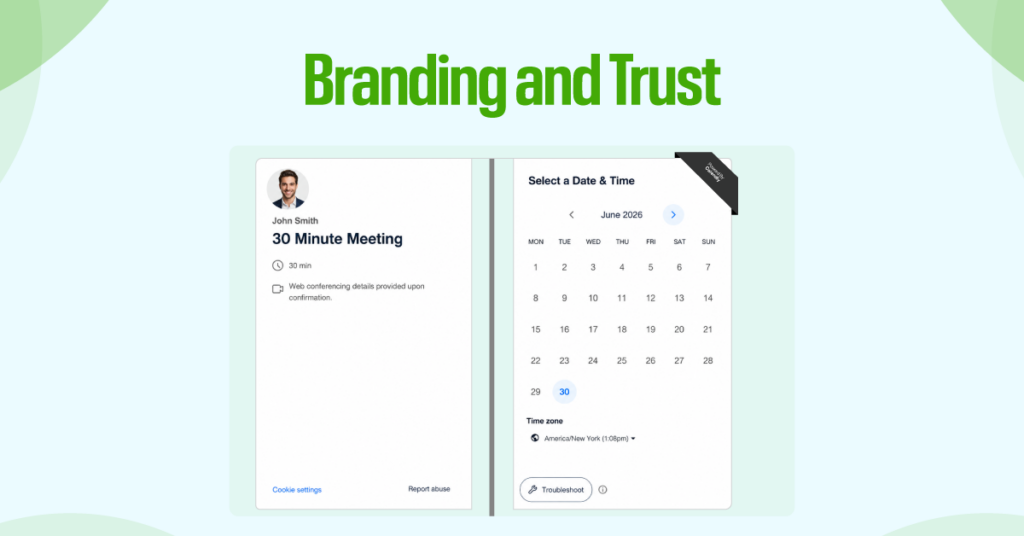
People book with brands they trust, and they decide which to trust within the first few seconds on the page. Branding is how you earn that trust before a word gets read.
Profile photo: Your headshot appears at the very top of the booking page, centered above your name and event list. It is the first visual a visitor lands on. A clear, friendly photo turns an anonymous scheduling form into a real person, and that shift in perception happens instantly.
Logo and brand colors: Your logo is in the top-left corner of the page. Your brand color carries through the booking button and selected date highlights. If someone arrives from a polished website and lands on a page with no logo and default blue buttons, the mismatch quietly signals that something is off. Keeping your colors and logo consistent removes that doubt.
Custom URL slug: This is the link you paste in emails, add to your website, and share on social. It looks like calendly.com/yourname/meeting-type and appears in the browser bar every time someone opens your page. A clean, readable slug like calendly.com/jane-smith/strategy-call signals professionalism. A default auto-generated string signals the page was never touched. Keep it short and specific to the meeting type.
5. Embed Strategy: Where and How to Place the Page
A raw link works, but embedding the page in the right context converts better, because context gives the booking its reason.
Build a dedicated landing page instead of sending people to a bare widget. Put the value proposition at the top, what they get, and why it matters, then place the booking widget right below it. It closes the gap between wanting to book and actually booking, so there is no extra click for hesitation to creep in.
Add social proof next to the widget. Testimonials, client logos, results, or a short case study beside the calendar reassure the visitor at the moment of decision. Proof works best where the action happens, not on a separate page that they will never open.
Restate the value proposition on the page itself. Do not assume the visitor remembers why they clicked. Saying the benefit again makes the calendar feel like the obvious next step instead of a leap.
6. Page Speed and Mobile: The Failures Nobody Checks
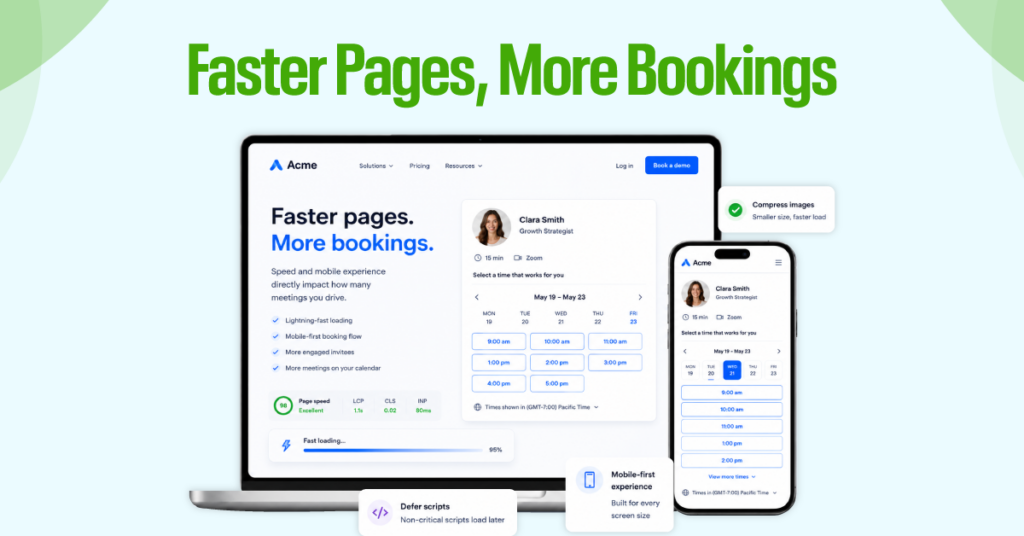
You can do everything above perfectly and still lose bookings to a slow page.
When you embed Calendly on your own site, your page load time becomes part of the booking experience. If the calendar takes too long to appear, people assume something is broken and leave before they ever see a time slot. Research on web performance consistently shows that conversion drops as load time increases, and the decline starts within the first couple of seconds.
The fix usually comes down to keeping the page light: compress large images and ensure the Calendly embed doesn’t slow everything else down while it loads.
Besides, a large share of booking traffic comes from phones, so test your page on a real device. Make sure the calendar scrolls cleanly, the time slots are easy to tap, and the form fits the screen. If bookings feel low relative to your traffic, check speed and mobile before anything else.
7. Analytics and Tracking: Find Where Bookings Leak
If you do not track the booking flow, you have no way of knowing whether people are leaving because of a copy problem, a trust problem, or a form problem. Tracking gives you that answer.
Set up 3 major Google Analytics events:
- Page view — the visitor landed on your booking page
- Date selected — they engaged and picked a time slot
- Form submitted — they completed the booking
These 3 events show you exactly where people stop. A big drop between page views and date selected means people are arriving but not engaging, usually a copy, trust, or speed issue. A drop between the selected date and the form submission means people are willing but quit before finishing, usually because the form asks for too much.
Also, tag every link you share with UTM parameters. This tells you which channel is actually driving bookings, not just traffic. A source that sends 500 clicks and 2 bookings needs a different fix than one that sends 50 clicks and 20 bookings. Without UTMs, you cannot tell the difference.
A Checklist Before You Call the Page Done
- Profile photo, correct name, and accurate time zone set
- Logo and colors applied, badge removed if on a paid plan
- Clean, descriptive custom URL slug
- Event names that state value, not just duration
- Descriptions that set expectations and pre-qualify
- Confirmation and reminder text rewritten in your voice
- Working hours are limited to intentional blocks
- Buffers set before and after meetings
- Daily meeting limit in place
- All calendars are connected for accurate free/busy
- Intake form trimmed to essential questions only
- Page embedded on a landing page with value prop and social proof
- Page speed tested and optimized
- Mobile experience tested on a real device
- Google Analytics events and UTM tracking live
Final Thought
An optimized Calendly page does one thing well: it removes every reason a good prospect might hesitate, from the first impression down to the final click. You do not get there in a single sitting, and you do not need to.
Start with the changes that cost nothing and carry the most weight, the event names, the descriptions, the trimmed availability, then layer in branding, embedding, speed, and tracking as you go.
What separates a page that books from one that does not is rarely a dramatic redesign. It is the accumulation of small, deliberate choices: a faster load, a clearer title, one fewer form field, a photo that makes you look like a real person.
It helps to think of the page as the conversion point it already is, check it against the checklist above, and come back to it whenever your tracking shows people slipping away. With that habit in place, your booking page stops being a passive link and becomes one of your most reliable sources of the right meetings.